Nomid
NomidSamsung Knox vs. Google Zero-Touch: Which Bulk Enrollment Method is Best for Logistics?
In the fast-paced world of modern logistics, the flow of goods is entirely dependent on the flow of data. From warehouse pickers scanning barcodes to long-haul drivers logging delivery confirmations, rugged mobile devices are the lifeblood of the supply chain. However, managing these critical IT ...
Table of Contents
In the fast-paced world of modern logistics, the flow of goods is entirely dependent on the flow of data. From warehouse pickers scanning barcodes to long-haul drivers logging delivery confirmations, rugged mobile devices are the lifeblood of the supply chain. However, managing these critical IT assets presents a monumental challenge for logistics IT managers. High-turnover rates, seasonal workforce scaling, and the harsh physical realities of warehouse environments mean devices are constantly being deployed, repaired, wiped, and re-provisioned.
To survive this constant churn, logistics companies cannot rely on manual device setup. Hand-configuring individual devices is a catastrophic drain on IT resources and introduces unacceptable security vulnerabilities. Enter automated device provisioning. For Android fleets, the industry has standardized around two dominant bulk enrollment methods: Samsung Knox Mobile Enrollment (KME) and Google's Android Enterprise Zero-Touch Enrollment (ZTE).
Both platforms promise "out-of-the-box" readiness, allowing devices to automatically download configurations, security policies, and enterprise applications the moment they are powered on and connected to the internet. But when evaluating Samsung Knox vs Google Zero-Touch, which bulk enrollment method is best for logistics? This comprehensive comparison explores the technical architectures, hardware compatibility, and Total Cost of Ownership (TCO) implications of both methods, ultimately revealing how unifying them through a powerful Mobile Device Management (MDM) solution is the ultimate key to logistics IT asset management.
The Logistics Device Dilemma: Speed, Scale, and Rugged Hardware
Before comparing the enrollment platforms, it is critical to understand the unique operational realities of the logistics sector. Unlike corporate office environments where employees are issued a single smartphone for years, logistics environments are highly dynamic and physically demanding.
First, there is the issue of high-turnover device management. Logistics companies frequently hire hundreds or thousands of temporary workers during peak seasons (such as the Q4 holiday rush). Each of these workers requires a fully provisioned, locked-down device on day one. When the season ends, those devices must be instantly wiped and securely stored or reallocated. Manual provisioning--which typically takes 15 to 30 minutes per device--would require hundreds of IT hours per facility.
Second, the hardware itself is specialized. Logistics fleets rarely consist of standard consumer smartphones. Instead, they rely on rugged device deployment. These are drop-tested, dust-proof, and water-resistant devices from manufacturers like Zebra, Honeywell, Panasonic, and Samsung (specifically the Galaxy XCover and Tab Active series). These devices often feature built-in hardware barcode scanners, programmable push-to-talk buttons, and swappable batteries.
Finally, there is the security imperative. A lost or stolen delivery scanner contains direct access to corporate inventory databases, customer addresses, and proprietary routing algorithms. If a device falls off a truck, it must be completely inaccessible to unauthorized users and capable of being remotely wiped. Furthermore, if a thief attempts to factory reset the device, the enrollment method must force the device to re-enroll into the company's MDM upon reboot--a feature known as Factory Reset Protection (FRP).
Both Samsung KME and Google ZTE solve these problems by moving the enrollment process to the cloud, binding the device's unique hardware identifier (IMEI or Serial Number) to the company's MDM server before the box is even opened. However, they achieve this through different ecosystems.
Google Zero-Touch Enrollment (ZTE): The Universal Android Standard
Google Zero-Touch Enrollment (ZTE) is a core component of the Android Enterprise framework. Introduced as a universal standard for automated device provisioning on Android, ZTE is designed to provide a consistent deployment experience regardless of the device manufacturer.
How Google Zero-Touch Works
ZTE operates through a web-based portal managed by Google. When a logistics company purchases a fleet of rugged devices, they must buy them from an authorized Zero-Touch reseller. Upon purchase, the reseller uploads the devices' IMEIs or Serial Numbers directly into the customer's ZTE portal. The IT administrator then logs into the portal and assigns an MDM profile to those devices.
When the warehouse worker powers on the device for the first time and connects to Wi-Fi or a cellular network, the device checks in with Google's servers. Recognizing its IMEI, Google instructs the device to download the assigned MDM agent, bypassing the standard consumer setup screens. The MDM then takes over, locking the device into a dedicated logistics kiosk mode, installing inventory apps, and applying security policies.
The Advantages for Logistics
- Universal Compatibility: ZTE is the undisputed champion of mixed-fleet environments. If your logistics company uses Zebra scanners in the warehouse, Panasonic tablets in the forklifts, and Motorola devices for the delivery drivers, ZTE can handle them all from a single portal. It is supported on almost all GMS (Google Mobile Services) certified devices running Android 8.0 or higher.
- Streamlined Reseller Integration: Because the reseller handles the heavy lifting of uploading device identifiers to the portal, IT teams are freed from manual data entry. You simply order 500 devices, and they appear in your portal ready for MDM assignment.
- Unbreakable Factory Reset Protection: If a device is stolen and hard-reset, it will inevitably phone home to Google during the initial setup wizard. ZTE will force the device right back into your MDM's control, rendering it useless to thieves.
The Limitations
The primary limitation of ZTE is its strict reliance on authorized resellers. If your company purchases devices second-hand, or buys them from an unauthorized vendor to save costs, you cannot easily add them to the ZTE portal. While Google has introduced ways for MDMs to manually add devices to ZTE using a "DPC extra" provisioning method, it requires physical interaction with the device, negating the "zero-touch" philosophy.
Samsung Knox Mobile Enrollment (KME): The Galaxy Ecosystem Powerhouse
While Google built a universal standard, Samsung built a deeply integrated, hardware-level ecosystem. Samsung Knox Mobile Enrollment (KME) is a proprietary bulk enrollment method designed exclusively for Samsung Galaxy devices. Because Samsung manufactures both the hardware and the Knox security software, KME offers capabilities that operate below the operating system level.
How Samsung KME Works
Similar to ZTE, KME utilizes a cloud-based portal. When purchasing rugged Samsung devices (like the XCover Pro or Tab Active), authorized Samsung resellers upload the device identifiers to the KME portal. The IT administrator assigns an MDM profile, and upon boot-up, the device automatically enrolls.
The Advantages for Logistics
- Deep Hardware Integration: KME is tied to the Samsung Knox platform, an incredibly robust, defense-grade security framework built directly into the device's microchip. This provides logistics companies with unparalleled control over hardware components, allowing IT to disable cameras, remap physical hardware buttons (e.g., turning a volume key into a barcode scan trigger), and manage battery charging limits to extend the lifespan of high-turnover devices.
- The Knox Deployment App (KDA): This is a massive advantage for KME. If a logistics company acquires Samsung devices outside of an authorized reseller, IT can use the Knox Deployment App on a master device to instantly enroll the new devices via Wi-Fi Direct, Bluetooth, or NFC. This provides a critical fallback for mixed-procurement strategies.
- Advanced Certificate Management: For logistics companies operating highly secure, closed internal networks, KME allows for the silent, automated deployment of complex Wi-Fi and VPN certificates before the MDM even takes over.
The Limitations
The limitation of KME is obvious: it only works on Samsung devices. If your logistics operation relies on a diverse hardware ecosystem featuring Zebra, Honeywell, or Datalogic scanners alongside Samsung tablets, KME cannot serve as your single pane of glass for enrollment. You will be forced to use KME for your Samsung devices and another method for the rest.
Head-to-Head Comparison: KME vs. ZTE for Logistics
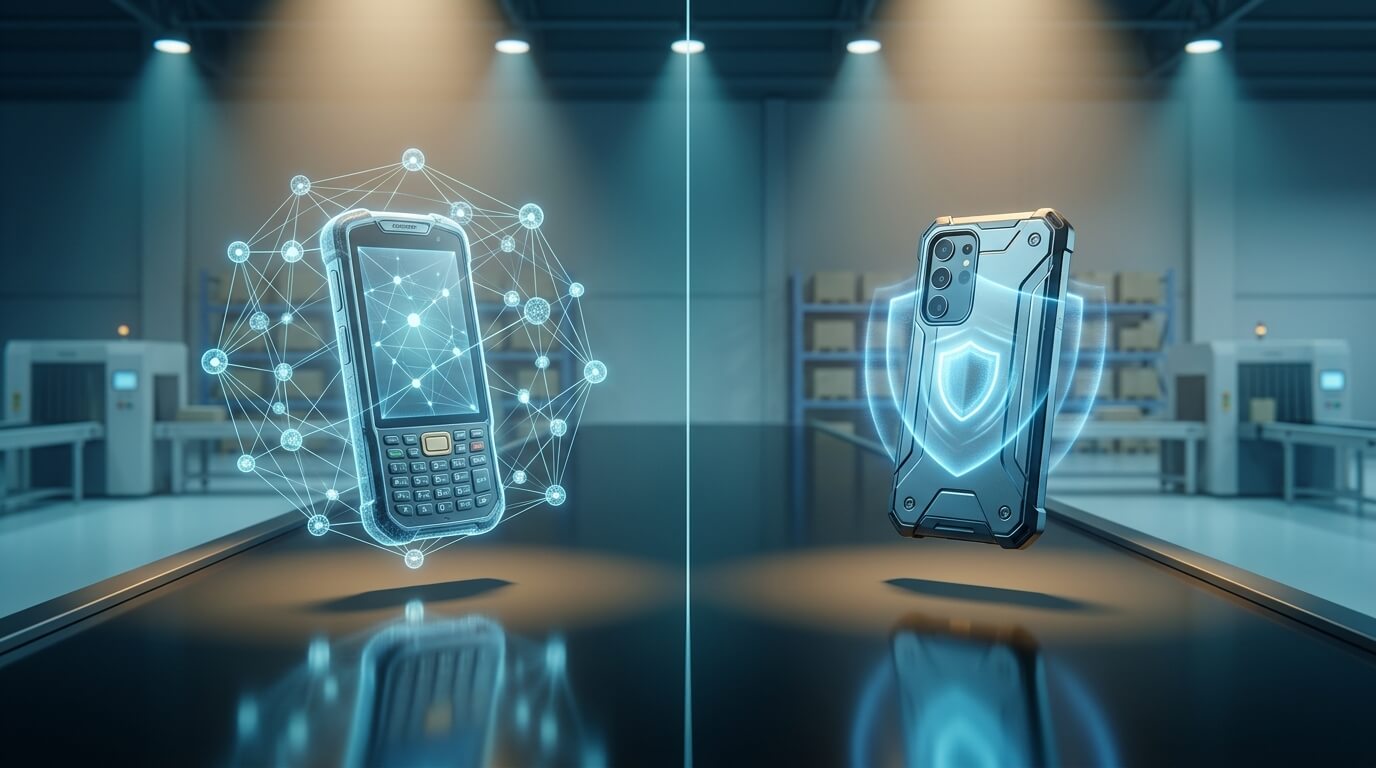
To make an objective decision regarding automated device provisioning for Android, logistics IT managers must weigh these platforms across several critical metrics. Below is a data-driven comparison of Samsung Knox vs Google Zero-Touch.
| Feature / Metric | Google Zero-Touch (ZTE) | Samsung Knox (KME) |
|---|---|---|
| Hardware Compatibility | Universal (Any Android 8.0+ GMS device) | Samsung Galaxy devices only |
| Reseller Dependency | High (Requires Authorized ZTE Reseller) | Moderate (Reseller preferred, but KDA app allows manual bypass) |
| Offline Enrollment | No (Requires internet for initial ping) | Yes (Via Knox Deployment App / NFC / Wi-Fi Direct) |
| Security Depth | OS Level (Android Enterprise) | Hardware Level (Knox TrustZone) |
| Average Provisioning Time | 2-3 Minutes per device | 2-3 Minutes per device |
| Factory Reset Protection | Yes, mandatory re-enrollment | Yes, mandatory re-enrollment |
| Logistics Fit Score | 9.5/10 (Best for mixed rugged fleets) | 9.0/10 (Best for pure Samsung fleets) |
Pricing Context and TCO
When evaluating pricing context, it is important to understand that both Google ZTE and Samsung KME portals are completely free to use. Google does not charge for access to the ZTE portal, and Samsung does not charge for KME. The financial investment lies entirely in two areas: the hardware procurement (devices purchased through authorized resellers may lack the deep discounts of grey-market hardware) and the Mobile Device Management (MDM) software license required to actually manage the devices once they are enrolled.
Therefore, the choice between KME and ZTE rarely comes down to software licensing costs for the enrollment platform itself. Instead, the decision is driven by hardware strategy and MDM compatibility.

TCO Implications in High-Turnover Logistics Environments
To truly understand why bulk enrollment methods are critical for logistics, we must examine the Total Cost of Ownership (TCO) and the hidden costs of manual provisioning. Let us run a conservative metric model for a mid-sized logistics company scaling up for the holiday season.
The Scenario: Deploying 1,000 rugged Android devices for seasonal warehouse workers.
Manual Provisioning: An IT technician must unbox the device, connect to Wi-Fi, skip consumer setup screens, download the MDM agent, enter login credentials, and wait for policies to apply. Average time: 15 minutes per device.
- 1,000 devices × 15 minutes = 250 hours of IT labor.
- At an average IT hourly rate of $40, manual deployment costs $10,000 in labor alone, not accounting for human error, missed security configurations, or deployment delays.
Automated Provisioning (ZTE or KME): Devices are assigned to the MDM in the cloud portal. Devices are handed out in their boxes to the warehouse workers. The worker turns it on, and the device configures itself. Average IT time: 0 minutes per device.
- 1,000 devices × 0 minutes = 0 hours of physical IT labor.
- The IT team spends roughly 30 minutes configuring the global profile in the portal. Total deployment labor cost: $20.
Beyond initial deployment, automated enrollment drastically reduces hardware loss. In logistics, device shrinkage (lost or stolen devices) can account for up to 10% of a fleet annually. Because ZTE and KME feature unbreakable Factory Reset Protection, stolen devices cannot be repurposed or sold on the secondary market. This dramatically reduces the incentive for theft, protecting the company's hardware investment and, more importantly, securing corporate data.
Why Choose? Unifying KME and ZTE with Nomid MDM
The debate between Samsung Knox vs Google Zero-Touch often forces IT managers to feel as though they must lock themselves into a single hardware ecosystem. If you choose ZTE, you might miss out on the deep hardware controls of Samsung devices. If you choose KME, you are barred from utilizing cost-effective Zebra or Honeywell scanners.
The reality is that you do not have to choose. The secret to mastering logistics IT asset management is utilizing a powerful, agnostic Mobile Device Management platform that seamlessly integrates with both enrollment methods simultaneously.
This is where Nomid MDM dramatically changes the landscape for logistics companies. As an official Android Enterprise Partner, Nomid neutralizes the 'KME vs ZTE' dilemma. Nomid acts as the ultimate unifying command center, allowing you to leverage the strengths of both platforms without compromising on speed, security, or visibility.
The Nomid Advantage for Logistics
Nomid MDM is engineered specifically to handle the rigorous demands of high-turnover device management and rugged device deployment. By integrating Nomid into your logistics infrastructure, you unlock several strategic advantages:
- Lightning-Fast Device Deployment: Nomid natively supports both Google Zero-Touch and Samsung Knox Mobile Enrollment. From the Nomid dashboard, you can synchronize your ZTE and KME portals. Whether you are deploying 500 Samsung XCover Pros via KME or 500 Zebra TC52s via ZTE, they all flow instantly into your Nomid environment, receiving identical corporate policies in minutes.
- Industry-Specific Logistics Configurations: Once KME or ZTE hands the device over to Nomid, our platform applies logistics-specific configurations out-of-the-box. Nomid instantly locks devices into a customized Kiosk Mode, restricting users to only essential applications (like inventory management, routing software, and push-to-talk). This eliminates worker distraction, prevents unauthorized web browsing, and significantly reduces data usage costs.
- Advanced Location Tracking and Geofencing: For delivery fleets, knowing where your assets are is non-negotiable. Nomid provides real-time location tracking and geofencing capabilities. If a device leaves a designated warehouse or delivery zone, Nomid can automatically trigger an alert, lock the device, or initiate a remote wipe to protect sensitive data.
- Cost-Effective Scalability: While ZTE and KME are free, MDM licensing can be a massive burden for logistics companies with large, seasonal fleets. Nomid provides transparent, highly competitive pricing structures designed for scale. You pay for the powerful management features you need without being penalized for scaling your fleet during peak seasons.
- Unified Asset Visibility: Managing two separate enrollment portals can lead to fragmented reporting. Nomid consolidates all device data--regardless of whether it was enrolled via Knox or Zero-Touch--into a single, intuitive dashboard. IT managers can monitor battery health, track network connectivity, and push over-the-air (OTA) updates to the entire mixed fleet simultaneously.
Conclusion
When evaluating bulk enrollment methods for logistics, the choice between Samsung Knox Mobile Enrollment and Google Zero-Touch Enrollment ultimately depends on your hardware strategy. If your logistics infrastructure relies entirely on Samsung's robust ecosystem, KME offers unmatched, hardware-level control and offline deployment flexibility. Conversely, if your operations demand a diverse mix of rugged devices from various manufacturers, Google ZTE is the indispensable, universal standard that ensures a seamless, zero-touch experience across the board.
However, the most successful logistics companies recognize that they do not need to limit their hardware choices based on enrollment limitations. By implementing a sophisticated, official Android Enterprise Partner solution like Nomid MDM, IT managers can bridge the gap between KME and ZTE.
Nomid empowers your logistics operation to procure the best hardware for the job--be it Samsung, Zebra, Honeywell, or Panasonic--while maintaining a unified, lightning-fast deployment strategy. By automating provisioning, enforcing unbreakable security, and providing a single pane of glass for mixed-fleet management, Nomid MDM dramatically reduces IT overhead, eliminates manual configuration errors, and ensures your supply chain never misses a beat.
Ready to neutralize the deployment dilemma and take total control of your logistics fleet? Discover how Nomid MDM's seamless integration with both Android Enterprise Zero-Touch and Samsung Knox can transform your device management strategy today.
See the Nomid difference
Start a free trial and experience why teams choose Nomid MDM for Android device management.
Start for FreeRelated Articles
View all posts
Samsung KME vs Android Zero-Touch Enrollment
Compare Samsung KME and Android zero-touch by device scope, reseller setup, EMM requirements, enrollment flow, and rollout checks.

Android Enterprise Enrollment Checklist: IT Deployment Guide
Android Enterprise enrollment readiness requires five critical steps before unboxing your hardware: binding your Android Enterprise organization account, selecting your management mode (Fully Managed, Work Profile, or Dedicated Kiosk), provisioning network access and enrollment payloads (such as ...